
Calorimetry
Calorimetry is the science of measuring the flow of heat in chemical reactions. Calorimeters measure the change in temperature that results from a chemical reaction.
But temperature is not the same thing as heat. To connect temperature and energy, we use heat capacity.
Specific Heat Capacity
Specific Heat Capacity: The amount of heat energy needed to raise the temperature of 1 gram of a substance by 1˚C. The symbol for specific heat capacity is “c.” It is measured in J/(g * ˚C) or J/(g * K).
For example, water has a specific heat capacity of 4.184 J/(g * ˚C). This means that if you took one gram of water, it would take 4.184 joules to raise the temperature of that water by 1˚C.
We can use specific heat capacity to find heat change using the equation q = mc∆T, where ↴
– q = heat (in joules)
– m = mass (in grams)
– c = specific heat capacity
– ∆T = change in temperature in celsius (it would be the same in kelvin)
Heat Capacity: The amount of energy required to raise the temperature of an entire object/sample by 1˚C. Heat capacities are unique to specific samples because it factors in the mass of the sample. It is measured in J/˚C or J/K, and is represented by “C.”
C = mc
The heat capacity of a sample is equal to the mass of the sample multiplied by the specific heat capacity.
Ex. Water has a specific heat capacity of 4.184 J/(g · ˚C). If you have 10.0 grams of water, that sample of water has a heat capacity of 41.8 J/˚C. It would take 41.8 J to raise the temp of that entire sample of water by 1 degree.
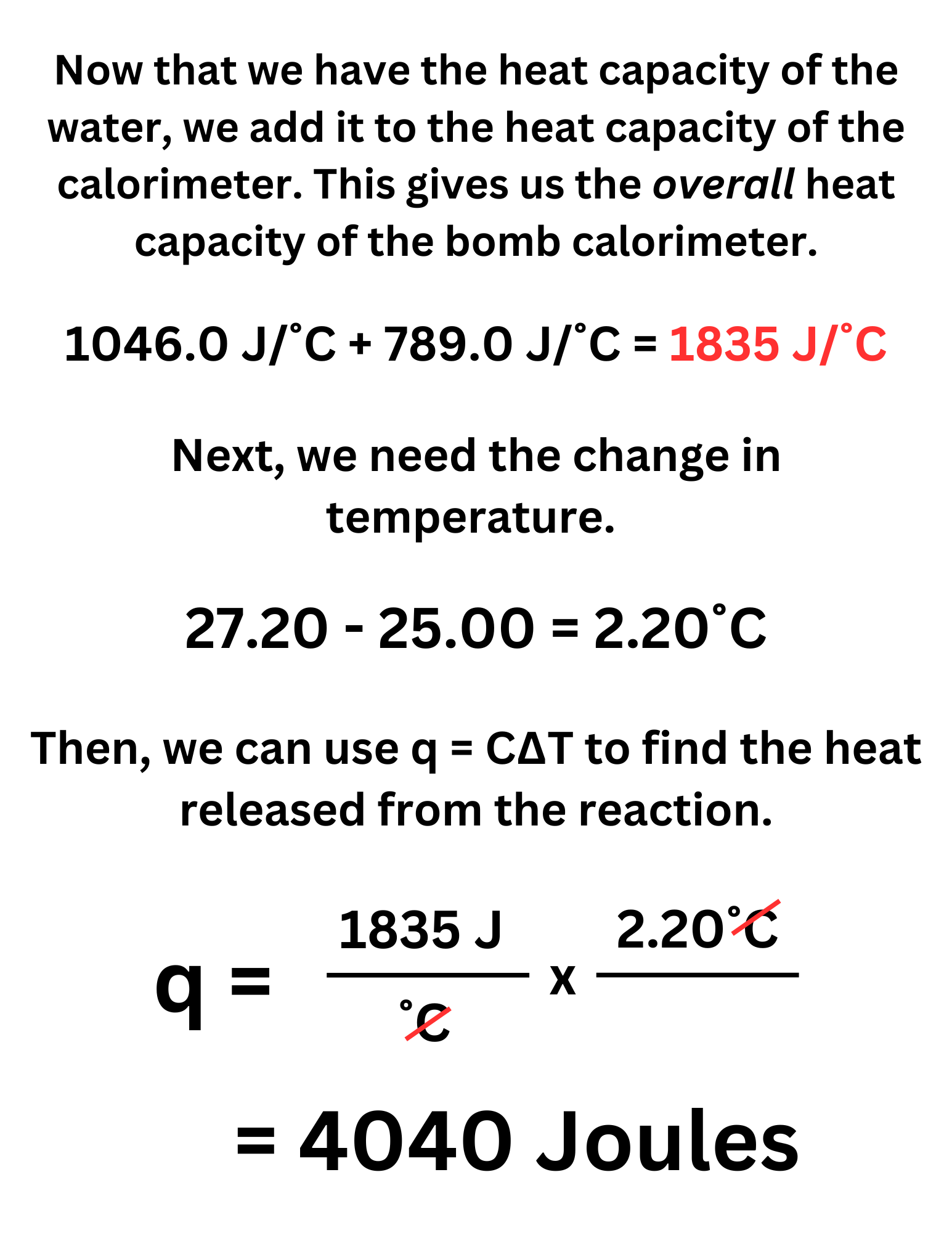
We can use heat capacity to find the heat change using the equation q = C∆T. Since heat capacity already factors in the mass of the sample, we don’t need to include mass in this equation (like we do in q = mc∆T).
The difference between specific heat capacity and heat capacity is that specific heat capacity does not change based on the amount of substance. Specific heat only depends on the substance itself. However, heat capacity is unique to each sample, even if those samples are made of the same substance.
For example, 1, 10, and 100 grams of water all have the same specific heat capacity (4.184 J/(g * ˚C)), since it is per gram of water. It does not matter how much water there actually is, because for every gram of water, it takes 4.184 J to raise the temperature by 1 ˚C. All samples of water have a specific heat capacity of 4.184 J/(g * ˚C).
On the other hand, the heat capacities are 4.184 J/˚C, 41.84 J/˚C, and 418.4 J/˚C respectively. These values describe the amount of energy required to raise the temperature of the entire sample by 1 ˚C. It makes sense that raising the temperature of 100 grams of water requires more energy than it would for just 10 grams of water.
When you have a mixture, its heat capacity is the sum of the heat capacities of the components in the mixture. Let’s imagine a plastic cup full of water. The plastic cup has a heat capacity of 22.62 J/˚C. The water inside the cup has a heat capacity of 472.79 J/˚C. As a whole, the cup and water have a heat capacity of 495.41 J/˚C. This means it would take 495.41 joules to raise the temperature of the water and cup by 1˚C.
This will be important in bomb calorimetry (below), where you will need to find the heat capacity of the bomb calorimeter, which is made of multiple components.
Bomb Calorimetry
Most calorimetry problems will use bomb calorimetry. The setup of a bomb calorimeter is simple. There is a steel bomb that contains the reactants. This bomb is submerged in a water bath. The bomb and water bath are inside of a sturdy, insulated, container. There is also a thermometer inside of a water bath that is used to measure the change in temperature.

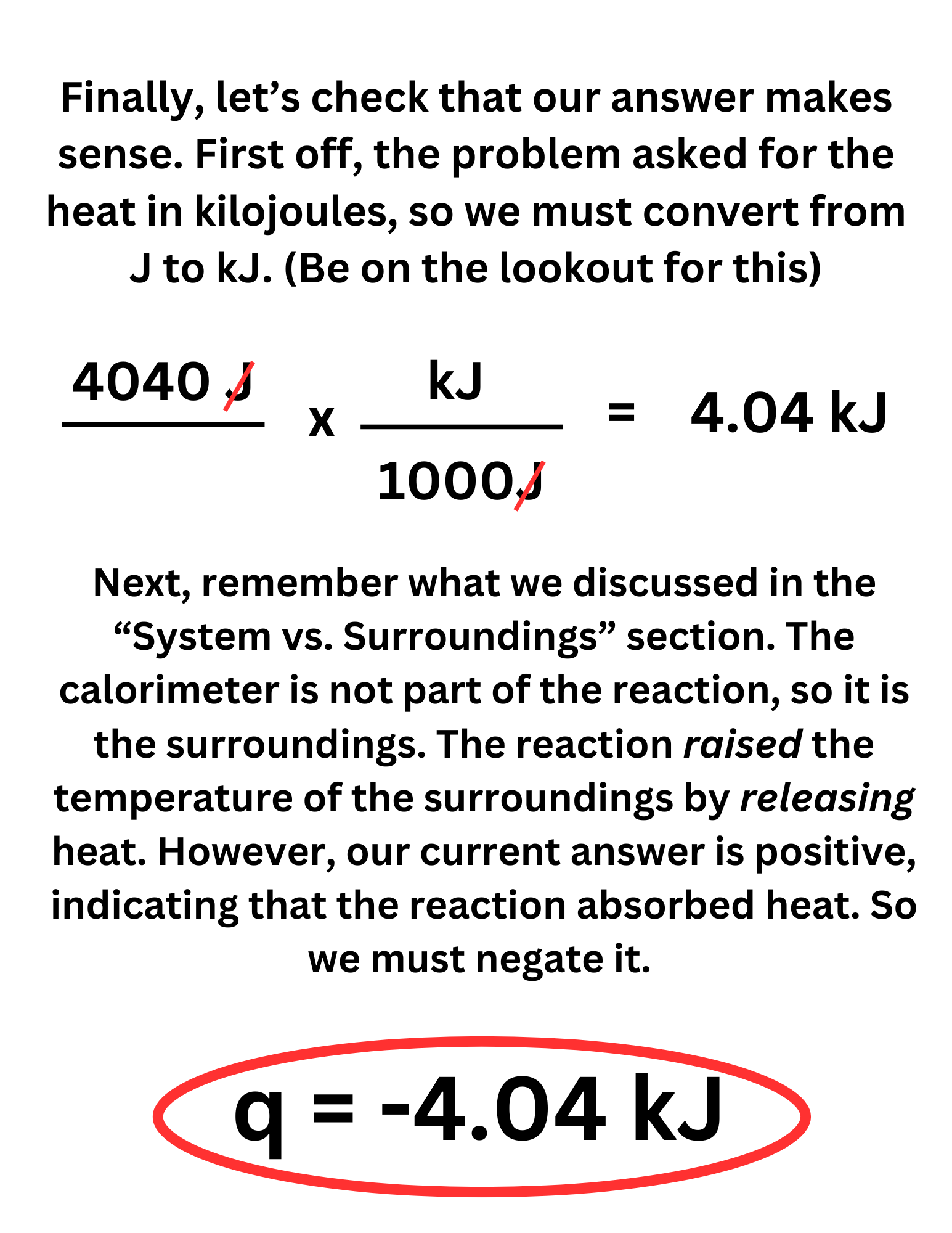
In bomb calorimetry problems, you will often be given the change in temperature of the calorimeter after a chemical reaction. Your goal is to find the heat released/absorbed.
You will need to find the combined heat capacity of the water and container. Then you can use q = C∆T to find the heat of the reaction.
Here’s an example ↴

Keep in mind that there are many other types of problems that you could be given.
Understand how to find the heat capacity of the total system (water & calorimeter). Also understand how to convert between temperature and energy using heat capacity.
 Chemistutor