
How it Works
Factor labeling is a method for converting between units of measurement. The main idea is that when you divide a unit by itself, that unit cancels out. This allows us to use ratios to convert from one unit to another.
Look at the example at the bottom if you are confused.
Another important concept is that you can flip ratios. For example, take the ratio 12 in/ft. This can also be written as 1 ft/12 in. Depending on whether you need to get from feet to inches or inches to feet, both ratios can be used.
Significant Figures
Unit conversions will come with their own set of significant figures, but there are only certain cases where a conversion’s sig figs matter. You would only consider the sig figs of the ratio when the conversion that you are using is not exact.
For example, ratios like 9.80665m/s² are often rounded to 9.8m/s², and because it is not an exact value, you would consider the two sig figs. Your answer can have no more than two sig figs.

However, if there was an exact conversion, like 1000 cm/m, you would not consider the one sig fig in the 1000 when doing any operations with it ↴

Here is an example converting from mph to m/s ↴
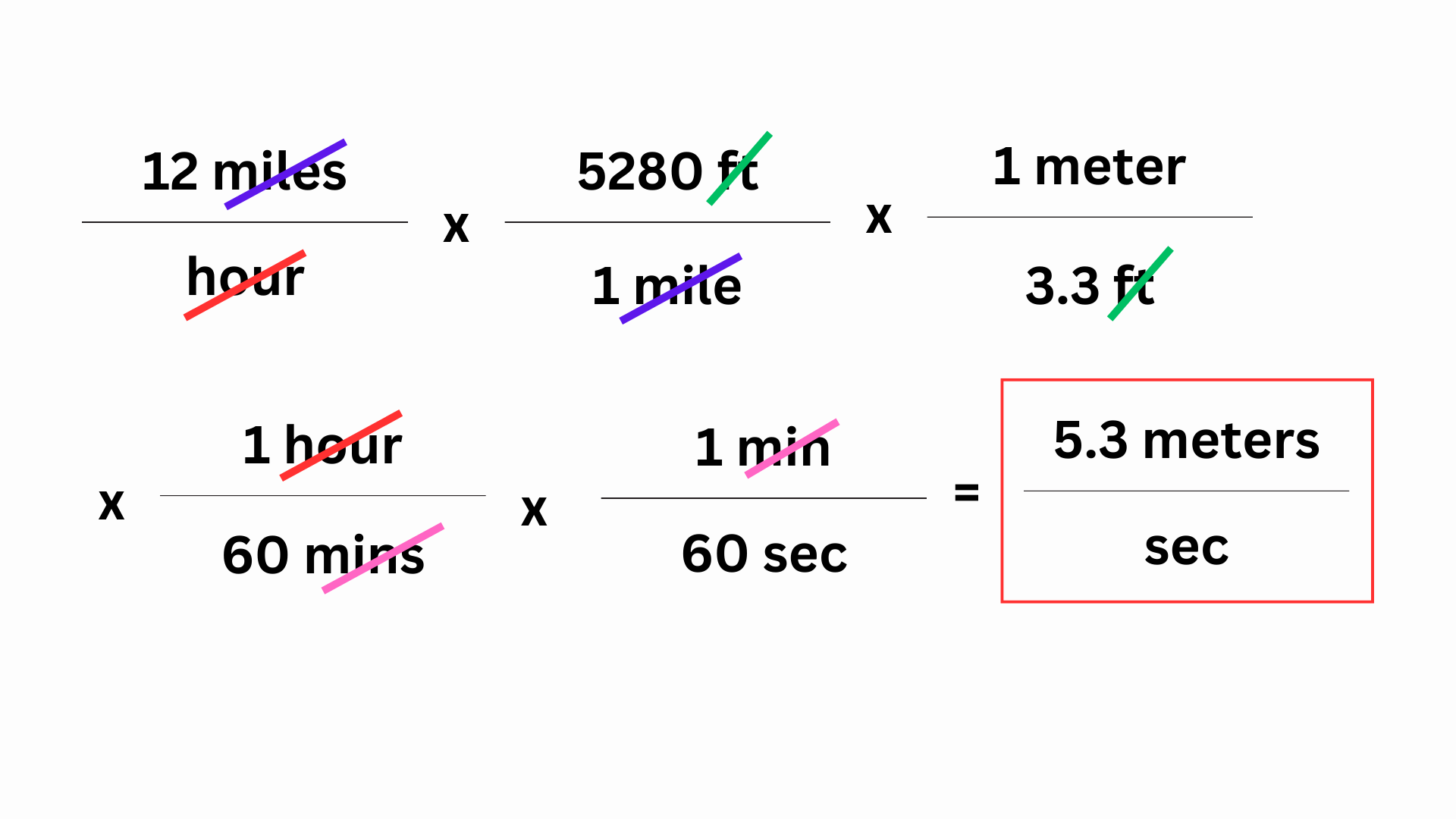
Above, we converted 12 mph to meters per second. Notice how we used ratios to convert between units. When a unit is in the numerator and denominator, we cancel it out.
 Chemistutor