
Quantum numbers are used to describe the energy and orbits of electrons. According to Pauli’s Exclusion Principle, no two electrons in the same atom can have the same four quantum numbers.
Principle Quantum Number (n)
This describes the energy level (“ring”) of the electron. The lowest energy level is n=1. The lower the n-value, the closer the electron is to the nucleus, and the less energy it has. The diagram below helps visualize what this quantum number represents.

Orbital Quantum Number (l)
This represents the shape of the electron’s orbital.
l = 0 → s orbital
l = 1 → p orbital
l = 2 → d orbital
l = 3 → f orbital
(These are explained in the “Orbitals” topic)
Each principal energy level (n quantum number) can have a range of l values from 0 to (n-1).
Ex. In the first energy level (n=1), it can only have the l value of 0. This means in the first principal energy level, there is only an s orbital.
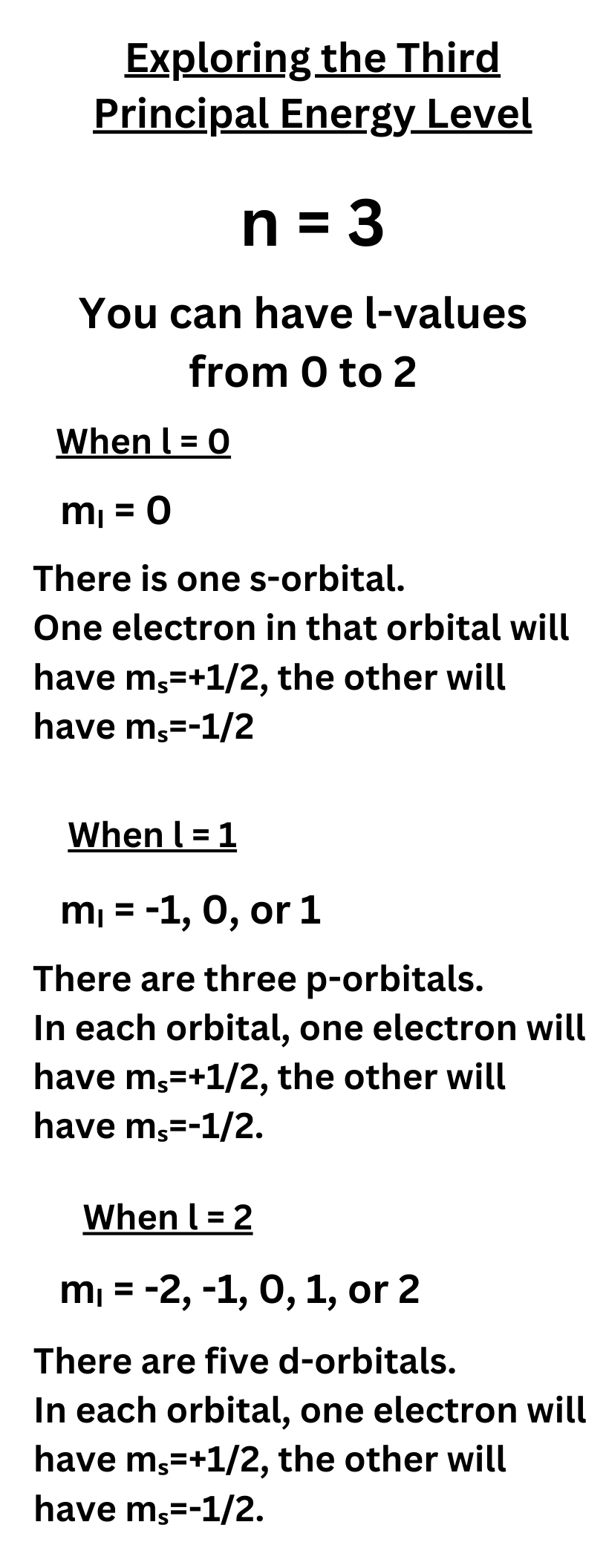
Ex. In the third energy level (n=3), it can have the l values of 0, 1, and 2. This means that the third energy level has s, p, and d orbitals, but no f orbitals.
Magnetic Quantum Number (mₗ)
Atoms have multiple orbitals of each shape. The magnetic quantum number describes which specific orbital the electron lies in.
The range of magnetic quantum number values in each orbital (for each l value) is –l to +l.
Ex. For the d-orbitals (l = 2), mₗ can equal -2, -1, 0, 1, or 2. This shows that per principal energy level, there are 5 d-orbitals that electrons can occupy, because there are 5 possible mₗ values.
Ex. For the p-orbitals (l = 1), mₗ can equal -1, 0, or 1. There are 3 possible mₗ values, so there are 3 p-orbitals per principal energy level.
Note that the actual value of mₗ is just used to distinguish between the different orbitals of the same shape. If a d-orbital is mₗ = -2, and another d-orbital is mₗ = 1, they are still the same type of orbital (d-orbital). It is just a way for us to distinguish between the 5 different d-orbitals in an energy level.
Spin Quantum Number (mₛ)
Each orbital holds two electrons. The only difference between these electrons is the direction that they spin.
These two electrons have the same n, l, and mₗ values. The only thing that distinguishes them is their mₛ values.
In an orbital, one electron will have a positive spin (mₛ = +½), and the other will have a negative spin (mₛ = -½)
Example
Let’s take a dive into the n=3 energy level, and look at the possible quantum numbers ↴
 Chemistutor