
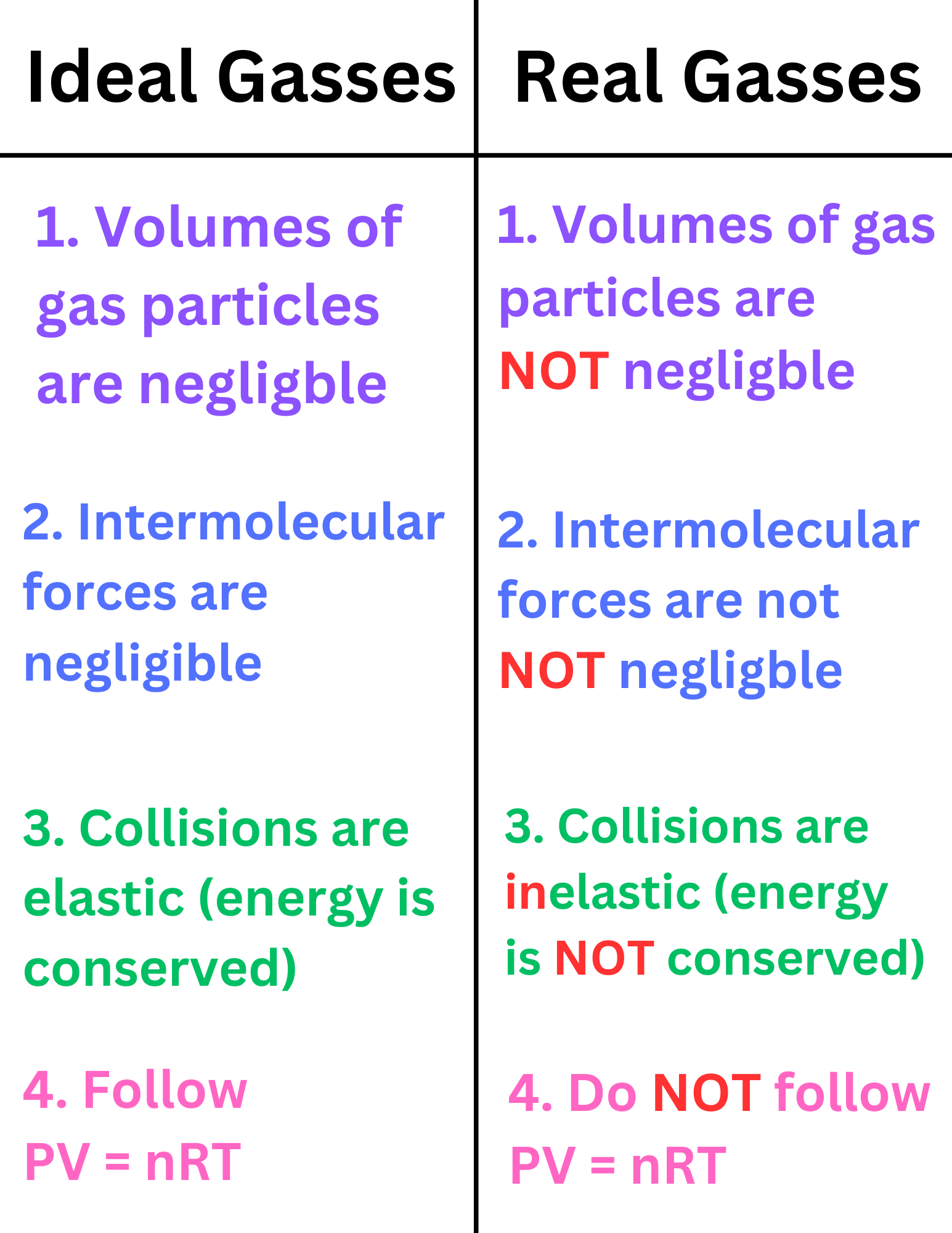
Ideal gasses follow the assumptions of the kinetic molecular theory. These gasses perfectly follow the ideal gas law (PV = nRT). However, in the real world, gasses tend to deviate from this “ideal behavior.”
Real gasses do not follow the assumptions of the kinetic molecular theory. They do not perfectly follow PV = nRT.
When we do calculations with gasses, we assume that they are ideal. This is similar to physics problems stating that “air resistance is negligible”, even though it would slightly influence the calculations. When doing gas law calculations, unless specified, assume that you are dealing with ideal gasses.
Ideal Conditions
Gasses behave more ideally at certain temperatures and pressures. We will be focusing on two postulates of the kinetic molecular theory ↴
1. The volumes of gas particles are negligible
2. Forces of attraction/repulsion between gas particles are negligible
These two assumptions are the most true at high temperatures and low pressures.
A high temperature results in the gas particles having high kinetic energy. They are moving fast, so they will easily be able to overcome forces of attraction between them. Higher temperatures make the forces of attraction between gas particles more negligible.
Low pressure means that the gas particles are not tightly compact. The volume of the container is large enough that the gas particles have sufficient space, and the volume of the particles is negligible.
So, at high temperatures and low pressures, the volume of gas particles and the forces of attraction between them are negligible. Therefore, the higher the temperature and the lower the pressure, the more ideally the gas behaves.
Nonideal Conditions
On the other hand, at high pressures and low temperatures, gas particles deviate the most from ideal behavior.
At high pressures, the gas particles are so compact that the volumes of the particles themselves are no longer negligible. At low temperatures, the kinetic energy of the particles is so low that interparticle attractions have a noticeable effect on the motion of the particles.
In summary, the higher the pressure and the lower the temperature the more the gas deviates from ideal behavior.
Example Problem
Which gas behaves the most ideally?
Which deviates most from ideal behavior?
A. O₂ at 500K and 1 atm
B. O₂ at 300K and 2 atm
C. O₂ at 800K and 0.2 atm
D. O₂ at 100K and 7 atm
Answer

 Chemistutor